Chini, a prominent representative of the Italian 'Liberty' style—the Italian variant of Art Nouveau—taught decorative arts at the Accademia di Belle Arti in Florence. He was responsible for various paintings and decorations in locations including the Cappella Brandini in Castelfiorentino, the church of San Francesco de' Ferri in Pisa, and the Ananta Samakhom Throne Hall in Bangkok. Furthermore, he contributed to the design and interior decoration of spaces within the Palazzo dei Congressi in Salsomaggiore Terme. In the realm of theater, he designed sets for productions such as the European premiere of Puccini’s opera *Gianni Schicchi* (Rome, January 1919) and the world premiere of the same composer’s *Turandot* (Milan, 1926). He also created the set designs for the premieres of the opera *La cena delle beffe* by Umberto Giordano (Milan, 1924) and the play of the same name by Sem Benelli, upon which the opera was based (Rome, 1909).
Inspired by Gustav Klimt, Chini created a series of decorative panels in 1914 titled *La Primavera* ('Spring'), which served as a backdrop for the works of the Croatian sculptor Ivan Meštrović (1883–1962) during the 1914 Venice Biennale.[2][3]
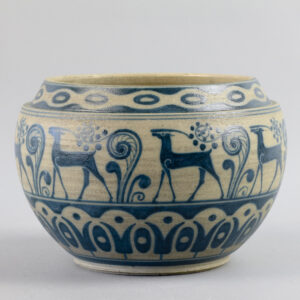
In 1896, Chini and several of his friends founded "Arte della Ceramica." The factory—which used a pomegranate and two interlocking hands as its logo—soon gained international renown. Chini’s vases and decorative objects immediately attained a prominent position in Italy, thanks to their early incorporation of a modernist visual language with strong Oriental influences. They won awards at numerous exhibitions—including a gold medal at the *Exposition des arts décoratifs* in Turin in 1898 (see E. Thovez, in *L’arte all’Esposizione del 1898*, IV, pp. 30–32), a Grand Prix at the 1900 Paris World’s Fair, and a Grand Prix in Saint Petersburg in 1901—and achieved great success at the International Exhibition of Decorative Arts in Turin in 1902 (Melani, 1902; Pica, 1903).
In 1907, together with his cousins Chino and Pietro, he founded the “Manifattura Fornaci S. Lorenzo – Chini & C. Borgo S. Lorenzo – Ceramica e vetri artistici.” This firm remained in operation until the Second World War (its mark consisted of a grid, sometimes accompanied by a stylized lily and the inscription “Mugello”). Chini served as artistic director, while Chino handled management. In addition to the traditional production of vases and decorative objects—with stoneware being used extensively until 1911—the factory also focused on stained glass and tiles.