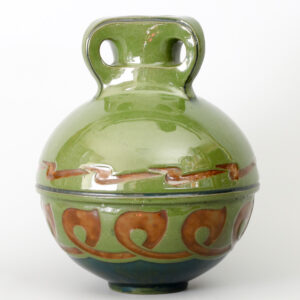
Along with Victor Horta, Van de Velde is considered one of the most important representatives of Art Nouveau.[22] He is also referred to as the "apostle of functionalism." From the early years of the 20th century, he played a leading role in architecture and the decorative arts, particularly in Germany.
In 1889, Van de Velde became a member of the artist group "Les XX" in Brussels. After Vincent van Gogh exhibited several works at the annual *Les XX* exhibition, Van de Velde was among the first painters to be influenced by him. During his honeymoon in the Netherlands, he visited the widow of Theo van Gogh—the brother of the recently deceased Vincent van Gogh. He gained a comprehensive view of the painter's body of work and realized that he would never attain such an extraordinary level of artistry. For him, this marked the end of his career as a painter.
From 1892 onwards, Van de Velde moved away from painting to focus on the applied arts (such as goldsmithing, porcelain and cutlery, fashion, and carpet and textile design) as well as architecture—including the construction of his own home in Uccle, "Bloemenwerf". In this house, the interior and its design formed an organic whole. In 1895, he designed interiors and furniture for "L'Art Nouveau", the influential art dealership run by gallerist Samuel Bing in Paris. Van de Velde's work was also featured in Bing's pavilion at the 1900 World's Fair in Paris. He was influenced by the English Arts and Crafts movement—specifically the work of John Ruskin and William Morris—and was one of the first architects and furniture designers to work in an abstract style characterized by curved lines. He opposed the copying of historical styles and firmly opted for original design. He sought to banish banality and ugliness from the human mind.
After the war, commissioned by Helene Kröller-Müller, Van de Velde designed a supervisor's house and a worker's cottage in Schipborg (building permits dated 1921), situated next to the "De Schepbord" farmhouse designed by architect Hendrik Petrus Berlage in 1914. Van de Velde designed the Kröller-Müller Museum in Otterlo, which finally opened in 1938.
Source: Wikipedia